/ THE FEED /

Read what ships.

Deep, recent reads ranked by depth and freshness.

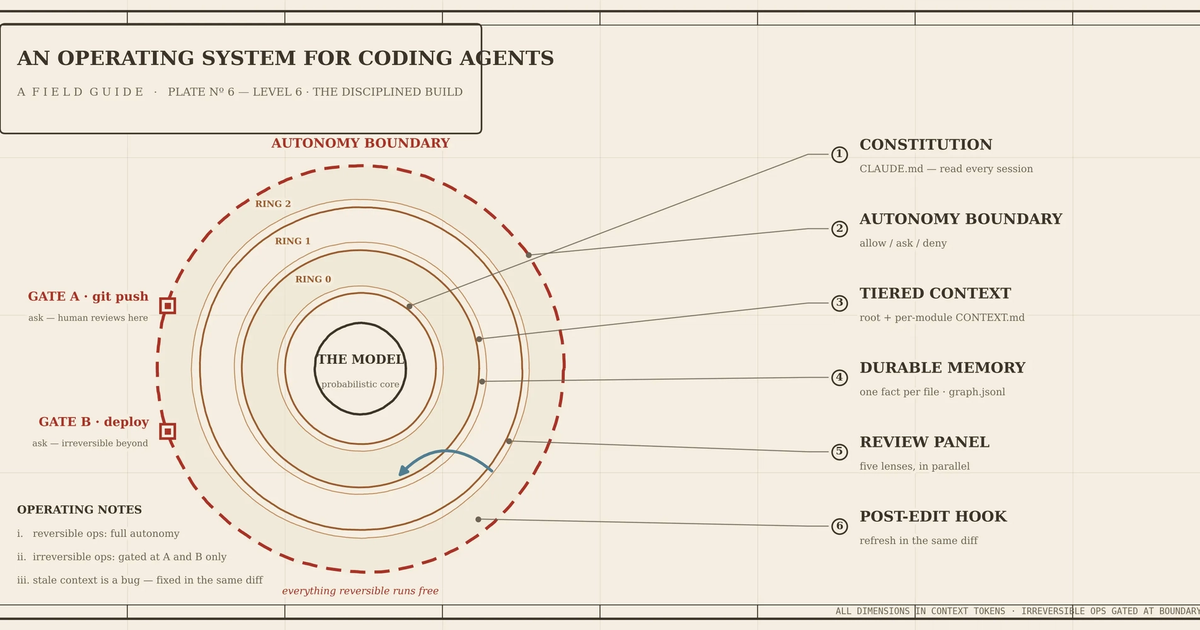
  1. Part 6: An operating system for coding agents: the disciplined build

    Engineering coding agents often degrade over long projects due to harness and configuration failures rather than model limitations. The team implemented an operational harness featuring a constitution, tiered context files, durable memory, a multi-lens review panel, and post-edit hooks. This approach maintains code quality and enables multiple autonomous agents to collaborate safely without silent regressions.

    DEPTH ■■■■■12 min read2 weeks ago
    Machine Learning

    Sign in to save and rate

  2. Rendering huge pull requests in the GitHub Copilot app

    Rendering extremely large pull requests with millions of lines and hundreds of comments requires separating deterministic code row geometry from unpredictable dynamic comment blocks. The team implemented an idle-gated measurement scheduler, separate height indices, and identity-based scroll anchoring to maintain smooth scrolling. As a result, the pull request view remains performant and responsive even under extreme loads.

    DEPTH ■■■■■14 min read4 weeks ago

    Sign in to save and rate

  3. Filter, reshape, and redact logs before export with Transformers

    Cloudflare integrated SQL-based log transformation directly into its Logpush export pipeline, allowing customers to filter, redact, and reshape logs before delivery. The team chose to embed the Apache DataFusion engine in-process using Rust and Go across an Arrow IPC boundary to ensure high throughput and avoid network latency. As a result, the system processes high-volume log streams efficiently while maintaining predictable resource usage and strict delivery reliability.

    DEPTH ■■■■■8 min read13 days ago

    Sign in to save and rate

  4. Helix: The internal tool powering our Shopify app's native migration

    Shopify is migrating its mobile apps from React Native to native Swift and Kotlin using an internal LLM-powered tool called Helix. Helix breaks migrations down into small checkpoints and enforces strict quality gates covering behavior, UI equivalence, architectural compliance, and human review. This iterative loop allows the team to reliably generate and migrate hundreds of screens to native code.

    DEPTH ■■■■■8 min read4 weeks ago

    Sign in to save and rate

  5. Application Metrics caught my broken size estimator

    An engineer integrated application metrics into a client-side video conversion tool to monitor file size estimation accuracy without using invasive telemetry. By tracking key performance indicators and analyzing the metric distributions, they discovered that an AI-generated estimation formula was flawed and producing results off by up to 83 percent. Replacing the broken logic with a correct bitrate-based formula brought the size estimation accuracy to within five percent of real-world results.

    DEPTH ■■■■■15 min read7 weeks ago

    Sign in to save and rate

  6. Deploy Oracle Database step by step on Amazon EVS with FSx for ONTAP

    This post provides a step-by-step guide to deploying Oracle Database 19c on Amazon Elastic VMware Service using Amazon FSx for NetApp ONTAP as an NFS datastore. It covers provisioning storage, mounting datastores, installing Oracle, configuring SnapMirror for cross-region disaster recovery, and outlining four migration paths. The result is a fully functional enterprise database deployment that preserves existing operational workflows.

    DEPTH ■■■■■11 min read3 weeks ago

    Sign in to save and rate

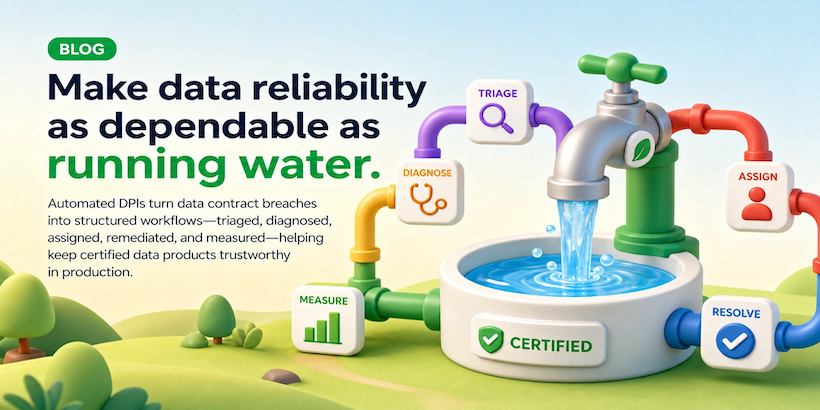
  7. Data Mesh at Grab (Part III): Operationalizing data reliability with automated DPIs

    Grab addressed runtime data reliability issues in its data mesh by implementing automated Data Production Issues (DPIs). The system uses an incident orchestrator to detect contract breaches, a Data Health API for cross-platform root cause analysis, and Hugo for automated remediation. This approach resolved 86.9 percent of incidents automatically and made mean time to resolve six times faster.

    DEPTH ■■■■■12 min read8 weeks ago

    DatabasesObservability

    Sign in to save and rate

  8. Why model versioning is not enough for production AI

    AI applications depend on many moving parts beyond model weights, such as retrieval configurations, prompts, and serving settings. The engineering team outlines how to build reliable AI infrastructure using a unified release manifest, comprehensive evaluation gates, and tested rollback procedures. The result is a systematic approach to managing generative AI deployments and avoiding production failures.

    DEPTH ■■■■■8 min read3 weeks ago

    Machine Learning

    Sign in to save and rate

  9. Making Rust observability reliable at scale with OpenTelemetry

    Datadog engineers faced inconsistent tracing, broken spans, and context loss across Rust services due to fragmented tooling and unopinionated OpenTelemetry configurations. To fix this, they contributed upstream to OpenTelemetry to improve interoperability and built an opinionated Rust tracing library called dd-trace-rs. This reduced backend ingestion volume by 20x while increasing the rate of indexed spans per service by 3x.

    DEPTH ■■■■■10 min read7 weeks ago

    Sign in to save and rate

  10. Architect highly available Oracle Database on Amazon EVS and FSx for ONTAP

    Enterprises migrating Oracle databases to Amazon Elastic VMware Service face challenges with storage latency, disaster recovery, and operational consistency. The team designed a highly available architecture combining Amazon EVS bare metal instances with Amazon FSx for NetApp ONTAP NFS datastores and cross-region SnapMirror replication. The resulting setup delivers sub-millisecond storage latency, preserved VMware operational workflows, and robust disaster recovery capabilities.

    DEPTH ■■■■■12 min read3 weeks ago

    Sign in to save and rate

  11. Is Your “Human-in-the-Loop” Actually Slowing You Down? Here’s What We Learned

    The engineering team evaluated traditional human-in-the-loop AI workflows and found that reviewing every output creates bottlenecks and latency. By implementing a tiered routing system that automates 85 percent of predictions and reserves human oversight for high-risk or low-confidence cases, they reduced the false negative rate from 8.3 percent to 2.1 percent. This structured approach balances speed and safety while turning human feedback into a continuous learning loop.

    DEPTH ■■■■■11 min read3 weeks ago

    Machine Learning

    Sign in to save and rate

  12. Deploy open source Regional availability tools in your VPC

    Engineering teams planning multi-Region architectures often struggle with evaluating AWS service availability and managing compliance risks. The team built and open-sourced two VPC-hosted solutions that deploy an automated Regional availability dashboard and a workload analysis pipeline using CloudTrail and CloudFormation. This setup allows organizations to securely filter and inspect the 20 to 30 services they actually use instead of hundreds.

    DEPTH ■■■■■13 min read3 weeks ago

    Sign in to save and rate

  13. Migrating Shop app from React Native to native

    Shop migrated its mobile app from React Native to native Swift and Kotlin by leveraging AI coding agents to accelerate the rewrite. The migration resulted in improved startup times, higher session stability, smaller Android app sizes, and smoother rendering performance.

    DEPTH ■■■■■5 min read6 weeks ago

    Sign in to save and rate

  14. How we make AI coding more cost efficient without sacrificing task quality

    GitHub optimized GitHub Copilot to improve cost efficiency without sacrificing task quality by evaluating changes across the entire agentic workflow. The team implemented four targeted adjustments including selective output compression, removing unused line-number formatting, shortening prompts via meta-prompting with behavioral tests, and delivering background work completions directly. These modifications reduced token usage and model inference costs globally without causing task-success regressions.

    DEPTH ■■■■■9 min read7 weeks ago

    Machine Learning

    Sign in to save and rate

  15. Accelerating airline retailing innovation: how Datalex modernized with AWS Experience-Based Acceleration and agentic AI

    Datalex partnered with AWS for a three-day Experience-Based Acceleration workshop to modernize its mission-critical airline retail platform from Java 8 and EJB2 to Spring Boot on Java 21. The team used parallel workstreams and agentic AI to prove migration feasibility, implement automated CI/CD pipelines, and integrate generative AI capabilities without disrupting existing airline operations. This effort successfully established repeatable migration patterns, reduced memory usage by 35%, and accelerated the timeline for long-term platform evolution.

    DEPTH ■■■■■14 min read3 weeks ago

    Sign in to save and rate

  16. Native is now the future of mobile at Shopify

    Shopify is migrating its mobile applications from React Native back to native Swift and Kotlin. The team determined that the emergence of advanced coding agents significantly reduces the cost of maintaining platform parity, making native development the superior choice again. To execute this migration efficiently, Shopify developed a system called Helix and a CLI-driven, agent-addressable architecture to enable fast, autonomous testing.

    DEPTH ■■■■■10 min read6 weeks ago

    Sign in to save and rate

  17. Running multi-day AZ evacuation drills with ARC Zonal Shift

    This post explains how to run multi-day Availability Zone evacuation drills using ARC Zonal Shift to prove application resilience under sustained stress. The team details step-by-step procedures across ECS, EKS, and PostgreSQL databases to uncover hidden failure modes like unoptimized scaling and stale connections. The result is a practical framework for moving from theoretical multi-AZ architectures to proven operational resilience.

    DEPTH ■■■■■19 min read3 weeks ago

    Sign in to save and rate

  18. How MHK built a HIPAA-eligible agentic AI solution on Amazon Bedrock

    Healthcare technology company MHK faced fragmented AI infrastructure and lengthy development cycles while trying to process unstructured medical documents under strict HIPAA standards. To solve this, they built a multi-tenant, event-driven agentic workflow framework called the SmartProminence AI Orchestrator on AWS using Amazon Bedrock, ECS, and SQS. The new system reduced manual review effort by 90% and shortened AI feature deployment times from months to weeks.

    DEPTH ■■■■■12 min read3 weeks ago

    Sign in to save and rate

  19. How River takes security work from a fix to merge

    Shopify developed an AI agent named River to automate security vulnerability remediation from dependency upgrades to pull request merges. The agent validates live states, replays and repairs fixes on current repository heads, and escalates context-dependent decisions to human engineers. This workflow reduced the open issue backlog by about 70 percent and increased freshness-gated security merges significantly.

    DEPTH ■■■■■9 min read7 weeks ago

    Sign in to save and rate

  20. Build adaptive AI interfaces with the AG-UI protocol, agent swarms, and Nova Act on AWS

    AI applications produce variable outputs that cannot be effectively handled by static user interfaces, leading to development friction and poor user experiences. The team implemented an adaptive interface pattern using the AG-UI protocol, the Strands Agents SDK Swarm pattern, and Amazon Nova Act on AWS to dynamically render components and automate legacy integrations. This architecture streams agent findings over Server-Sent Events, enabling real-time multi-agent consensus and reducing interface development overhead.

    DEPTH ■■■■■22 min read3 weeks ago

    Sign in to save and rate