/ THE FEED /

Read what ships.

Deep, recent reads ranked by depth and freshness.

  1. Origin Range Requests: Serving large files without range-request tuning

    Cloudflare replaced a legacy, fixed-size range caching design that suffered from bandwidth waste and memory pressure with a Pingora-based chunk coordinator. The new implementation dynamically combines cached chunks and aligned origin fetches to serve range requests accurately without manual tuning. This approach cut p99 time to first byte in half for R2 storage and reduced tiered cache traffic by six percent.

    DEPTH ■■■■■8 min read2 days ago

    DatabasesPerformanceRedis

    Sign in to save and rate

  2. Shard design doesn't start from your tables

    Designing a sharded Postgres architecture requires grouping tables around shared query keys rather than starting from table structures alone. The post details how to configure shard groups, reference tables, SQL expressions in shard indexes, and global secondary indexes using Neki. This setup enables efficient single-shard queries and transactions while maintaining full Postgres semantics.

    DEPTH ■■■■■8 min read2 days ago

    PostgreSQL

    Sign in to save and rate

  3. I don't trust ON DELETE CASCADE

    Postgres ON DELETE CASCADE can cause production outages, replication failures, and performance degradation during large deletions or schema migrations due to long-running transactions holding locks and generating massive WAL. The author recommends using soft deletes with batched background cleanup instead to keep transactions short and bounded. This approach avoids table locks and simplifies data recovery.

    DEPTH ■■■■■5 min read4 days ago

    PostgreSQL

    Sign in to save and rate

  4. What gets TOASTed in Postgres

    This post examines how PostgreSQL uses TOAST to manage oversized rows and variable-length columns through compression and off-row storage. It compares the pglz and LZ4 compression algorithms across different workloads, highlighting trade-offs in search windows, file sizes, and CPU overhead. The analysis demonstrates how these mechanisms impact storage efficiency and read performance for large text and JSON data.

    DEPTH ■■■■■12 min read13 days ago

    PostgreSQL

    Sign in to save and rate

  5. Improving site performance by shipping more CSS

    GitHub faced performance degradation on server-side rendering and initial page loads due to scaling issues with its CSS-in-JS solution. The engineering team executed a multi-year migration to CSS Modules and eliminated dynamic styling props using incremental rollouts, wrapper components, and automation tools. This resulted in significant performance gains, including 55% faster server-side rendering and the complete removal of styled-components.

    DEPTH ■■■■■8 min read4 weeks ago

    FrontendPerformance

    Sign in to save and rate

  6. The Regression Tests Nobody Writes: Capturing How Software Actually Behaves

    Standard regression tests usually only verify developer intent rather than the actual, unwritten behaviors that systems accumulate in production over time. By capturing real production traffic and network-level interactions, teams can build characterization test suites to automatically detect unintended behavioral shifts. This approach prevents accidental regressions during legacy refactoring, rewrites, and major framework upgrades.

    DEPTH ■■■■■6 min read3 days ago

    Testing

    Sign in to save and rate

  7. TIN v1.0.6: 2-3x faster, with support for stemming

    Following competitive benchmarks that highlighted opportunities for optimization, the developers of the TIN full-text search index for Postgres released versions 1.0.4 and 1.0.6. These updates added Snowball stemming for 18 languages, optimized top-k sorting queries with deterministic tiebreakers, and improved overall query performance. As a result, benchmark tests show that TIN outperforms competing extensions across conjunction, disjunction, and phrase query workloads.

    DEPTH ■■■■■8 min read2 weeks ago

    PostgreSQL

    Sign in to save and rate

  8. Your next job doesn’t have a title yet: Emerging role skills Q&A with Cory Hymel of Andela

    Researchers analyzed thousands of job postings to understand how artificial intelligence is changing technical skill requirements. The findings indicate that instead of creating a workforce of pure generalists, the market is developing distinct new specialized skill bundles and hybrid roles. Consequently, organizations are facing talent debt as the half-life of technical skills rapidly shrinks.

    DEPTH ■■■■■15 min read11 days ago

    Testing

    Sign in to save and rate

  9. Smarter personalization: How property data helps us understand user price sensitivity

    Existing user personalization systems fail to systematically account for residential property values, leading to one-dimensional profiles and regional blind spots. A conceptual four-step method is proposed that combines public property data, large language models, building-level price estimation, and hierarchical clustering to classify user affluence. The approach remains unimplemented, with future viability depending on technical validation, data quality, and privacy approvals.

    DEPTH ■■■■■4 min read2 weeks ago

    Data EngineeringMachine Learning

    Sign in to save and rate

  10. Data Mesh at Grab (Part III): Operationalizing data reliability with automated DPIs

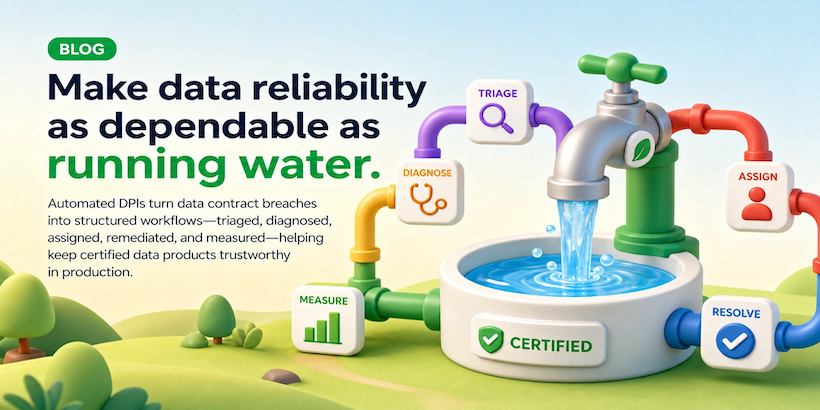
    Grab addressed runtime data reliability issues in its data mesh by implementing automated Data Production Issues (DPIs). The system uses an incident orchestrator to detect contract breaches, a Data Health API for cross-platform root cause analysis, and Hugo for automated remediation. This approach resolved 86.9 percent of incidents automatically and made mean time to resolve six times faster.

    DEPTH ■■■■■12 min read8 weeks ago

    DatabasesObservability

    Sign in to save and rate

  11. GrabMart data for faster disease outbreak detection

    The organization proposes a conceptual data pipeline to analyze aggregated GrabMart transaction data for symptom-related product demand, aiming to supplement clinical surveillance for disease outbreaks. The design relies on data aggregation, statistical baseline comparisons, and privacy safeguards like differential privacy without involving individual health inference. The system remains in an early planning phase requiring rigorous validation, privacy review, and public health oversight.

    DEPTH ■■■■■5 min read12 days ago

    Data EngineeringMachine Learning

    Sign in to save and rate

  12. Taking a look under your agent’s hood

    This post discusses the challenges and methods of applying observability to AI agents, which combine traditional distributed systems telemetry with new requirements for monitoring LLMs and multi-step tool calls. The discussion highlights how non-deterministic agent behavior and increased speed of execution make continuous production feedback loops essential for upstream development. Ultimately, integrating observability data into automated testing and development loops helps teams iterate on agent performance.

    DEPTH ■■■■■25 min read2 weeks ago

    Machine LearningObservability

    Sign in to save and rate

  13. Handling hot shards

    Growing applications often encounter hot shards when certain tenants or data subsets outgrow initial sharding strategies based on workspace IDs. To mitigate this, teams can scale up resources, isolate large tenants into specific key ranges, or fundamentally change the shard key for problematic tables based on access patterns. Neki facilitates these adjustments by allowing declarative data topologies and online resharding without downtime.

    DEPTH ■■■■■7 min read3 weeks ago

    MySQLPostgreSQL

    Sign in to save and rate