/ THE FEED /

Read what ships.

Deep, recent reads ranked by depth and freshness.

  1. Origin Range Requests: Serving large files without range-request tuning

    Cloudflare replaced a legacy, fixed-size range caching design that suffered from bandwidth waste and memory pressure with a Pingora-based chunk coordinator. The new implementation dynamically combines cached chunks and aligned origin fetches to serve range requests accurately without manual tuning. This approach cut p99 time to first byte in half for R2 storage and reduced tiered cache traffic by six percent.

    DEPTH ■■■■■8 min read3 days ago

    DatabasesPerformanceRedis

    Sign in to save and rate

  2. Shard design doesn't start from your tables

    Designing a sharded Postgres architecture requires grouping tables around shared query keys rather than starting from table structures alone. The post details how to configure shard groups, reference tables, SQL expressions in shard indexes, and global secondary indexes using Neki. This setup enables efficient single-shard queries and transactions while maintaining full Postgres semantics.

    DEPTH ■■■■■8 min read4 days ago

    PostgreSQL

    Sign in to save and rate

  3. The Pulse: Anthropic builds its own source control system

    Anthropic experienced a massive increase in code merges due to the heavy use of AI coding agents, which quickly overwhelmed standard Git scaling limits and CI checkouts. To solve this, a small engineering team built a custom centralized version control system called Scion backed by Google Spanner and Cloud Storage, along with a code review tool called Antique. This move successfully migrated the entire monorepo off Git and eliminated bottlenecks, though the architecture drew controversy over similarities to Meta's Mononoke.

    DEPTH ■■■■■12 min read4 days ago

    ArchitectureDistributed Systems

    Sign in to save and rate

  4. We gave AI agents a mobile dev environment

    Engineering teams outgrew their local machines while running parallel AI mobile development agents, constrained by heavy builds and lack of iOS tools on Linux. To solve this, they built Remote Dev using warm pools of remote Macs connected via SSH alongside separate Linux VMs for Android virtualization, paired with agent skills and live browser streaming. This setup shifted workflow bottlenecks, increasing AI-merged pull requests from 6 percent to 61 percent.

    DEPTH ■■■■■9 min read5 days ago

    ArchitectureMobile

    Sign in to save and rate

  5. PHP2Shell: GitLab helps find and remediate critical PHP flaws

    Critical remote code execution vulnerabilities known as PHP2Shell affect the PHP engine across multiple versions, requiring immediate runtime updates to fixed versions or patched distribution packages. The team utilized platform features like container scanning, code search, and automated agent workflows to locate PHP projects and remediate vulnerabilities. Operators must also check logs and environments for signs of compromise as framework updates and input validations cannot prevent these engine-level flaws.

    DEPTH ■■■■■10 min read5 days ago

    ArchitectureSecurity

    Sign in to save and rate

  6. App stability at scale with a layered defense

    To maintain app stability amidst rapid weekly releases and AI-generated code, Grab uses a layered defense strategy covering prevention, release gates, and incident response. This pipeline includes static analysis via custom lint rules, multiple tiers of automated and manual testing, a pre-production early access build, staged rollouts, and feature flags with instant kill switches. As a result, critical defects are caught early in the development lifecycle before reaching the wider production user base.

    DEPTH ■■■■■16 min read6 days ago

    MobileReliability

    Sign in to save and rate

  7. Bringing post-quantum cryptography to geographically fenced key management

    Cloudflare introduced a post-quantum geographically restricted key manager in closed beta to enforce data sovereignty and protect customers against harvest-now-decrypt-later attacks. The team implemented a hybrid ML-KEM-768 and X25519 cryptographic design that separates globally distributed wrapped private keys from regionally restricted root keys. This ensures that decryption keys are only accessible within authorized geographical boundaries and fails closed if validation fails.

    DEPTH ■■■■■12 min read3 days ago

    Security

    Sign in to save and rate

  8. How Shopify turns open models into task experts

    Shopify uses a continual learning flywheel to post-train open models, such as NVIDIA Nemotron, to serve as dedicated subagents for specific tasks like GraphQL generation. By optimizing inference and utilizing automated self-healing to generate training data from production failures, the team successfully created task experts that outperform frontier models while reducing serving costs by 90-98% and improving response times.

    DEPTH ■■■■■5 min read6 days ago

    Architecture

    Sign in to save and rate

  9. I don't trust ON DELETE CASCADE

    Postgres ON DELETE CASCADE can cause production outages, replication failures, and performance degradation during large deletions or schema migrations due to long-running transactions holding locks and generating massive WAL. The author recommends using soft deletes with batched background cleanup instead to keep transactions short and bounded. This approach avoids table locks and simplifies data recovery.

    DEPTH ■■■■■5 min read6 days ago

    PostgreSQL

    Sign in to save and rate

  10. Redesigning source control at Anthropic

    Anthropic experienced a massive surge in code generation due to AI coding tools, causing git to become a critical bottleneck for their monorepo. To scale, the team built Scion, a custom version control system optimized for online clients and server-side computation. This new architecture reduced infrastructure resource requirements by 200x and drastically improved checkout speeds for CI jobs.

    DEPTH ■■■■■17 min read2 weeks ago

    Architecture

    Sign in to save and rate

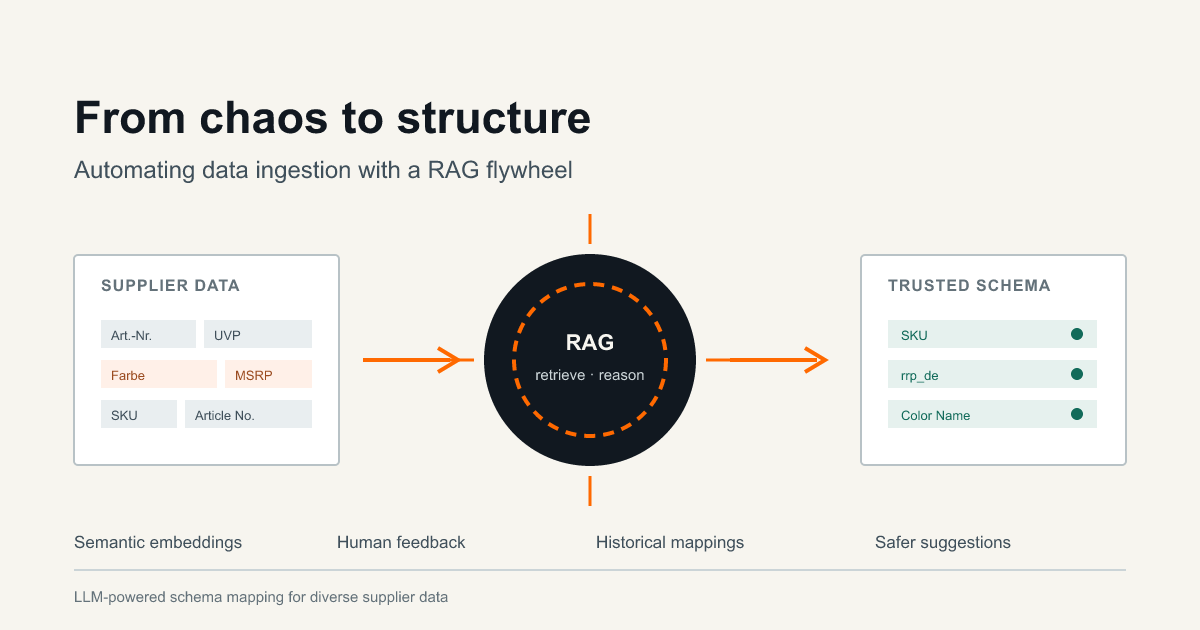
  11. Automating Data Ingestion with a RAG Flywheel

    Zalando replaced manual schema mapping for diverse supplier data with an LLM-powered Retrieval-Augmented Generation (RAG) flywheel. The system combines Amazon Titan embeddings stored in PostgreSQL via pgvector with tool-constrained generative models running at zero temperature. Every LLM suggestion passes through strict API validation checks before being reviewed by operations specialists, creating a continuous learning loop that improves future predictions.

    DEPTH ■■■■■14 min read2 weeks ago

    Machine LearningPostgreSQL

    Sign in to save and rate

  12. Cross-store product clustering across millions of stores

    Shopify needed to group identical product listings from millions of different merchants under a single global identifier. To solve this at scale without comparing every possible pair, the team implemented a multi-stage pipeline using vector retrieval, a tiered scoring system of ML models, and a bounded graph clustering approach. This architecture successfully standardizes product data across the entire platform while controlling computational costs.

    DEPTH ■■■■■13 min read6 days ago

    Architecture

    Sign in to save and rate

  13. Thundering herd of circuit breakers

    An engineering team investigated why a client-side circuit breaker repeatedly failed to close on its own after an outage. By exporting OpenTelemetry traces into a custom visualization tool, they discovered that low probe traffic caused the autoscaler to scale down the service to minimum capacity, triggering a thundering herd of requests and immediate timeouts the moment the circuit breaker closed. Adjusting the system to account for capacity and probe representativeness prevents this oscillation.

    DEPTH ■■■■■10 min read2 weeks ago

    MicroservicesObservabilityReliability

    Sign in to save and rate

  14. Under the hood, off the hot path: How D1 scales to millions of databases

    Cloudflare scaled its serverless SQLite database, D1, to support millions of databases by decoupling the control plane from the data plane. The team used distributed metadata caching via Workers KV, optimized database connections through Hyperdrive, and implemented a self-correcting heartbeat mechanism. This architecture prevents centralized bottlenecks and allows D1 to handle rapid on-demand database creation efficiently.

    DEPTH ■■■■■22 min read13 days ago

    Databases

    Sign in to save and rate

  15. What gets TOASTed in Postgres

    This post examines how PostgreSQL uses TOAST to manage oversized rows and variable-length columns through compression and off-row storage. It compares the pglz and LZ4 compression algorithms across different workloads, highlighting trade-offs in search windows, file sizes, and CPU overhead. The analysis demonstrates how these mechanisms impact storage efficiency and read performance for large text and JSON data.

    DEPTH ■■■■■12 min read2 weeks ago

    PostgreSQL

    Sign in to save and rate

  16. “Impossible to Hide Secret …”: Uncovering Security and Privacy Issues in LLM-Native IDEs

    Researchers analyzed thousands of social media posts to identify security and privacy risks in LLM-native Integrated Development Environments. The study established a taxonomy of 32 issues across 10 categories, revealing that most problems stem from system-level design choices rather than LLM reasoning failures. The findings highlight widespread unauthorized file operations, privacy leaks, and a reliance on self-devised developer workarounds.

    DEPTH ■■■■■3 min read2 weeks ago

    Machine LearningSecurity

    Sign in to save and rate

  17. Cloudflare deploys protections against php2shell vulnerability

    Recent disclosures revealed critical remote code execution and data exposure vulnerabilities in the PHP runtime. To mitigate the threat before public disclosure, Cloudflare developed full transaction detection to combine request and response signals within the WAF. This capability enabled automatic deployment of rules protecting customers against the php2shell exploits.

    DEPTH ■■■■■6 min read5 days ago

    Security

    Sign in to save and rate

  18. TIN v1.0.6: 2-3x faster, with support for stemming

    Following competitive benchmarks that highlighted opportunities for optimization, the developers of the TIN full-text search index for Postgres released versions 1.0.4 and 1.0.6. These updates added Snowball stemming for 18 languages, optimized top-k sorting queries with deterministic tiebreakers, and improved overall query performance. As a result, benchmark tests show that TIN outperforms competing extensions across conjunction, disjunction, and phrase query workloads.

    DEPTH ■■■■■8 min read2 weeks ago

    PostgreSQL

    Sign in to save and rate

  19. 8 eMudhra certificates are compromised. Here's what you need to know

    Private keys associated with eight eMudhra intermediate certificates were compromised, allowing potential traffic interception. Cloudflare prioritized patching critical services, released client and tunnel updates, and deployed mitigations across its products. Customers are advised to upgrade affected software, update custom trust stores, and avoid disabling verification despite error messages.

    DEPTH ■■■■■4 min read6 days ago

    Security

    Sign in to save and rate

  20. Smarter personalization: How property data helps us understand user price sensitivity

    Existing user personalization systems fail to systematically account for residential property values, leading to one-dimensional profiles and regional blind spots. A conceptual four-step method is proposed that combines public property data, large language models, building-level price estimation, and hierarchical clustering to classify user affluence. The approach remains unimplemented, with future viability depending on technical validation, data quality, and privacy approvals.

    DEPTH ■■■■■4 min read3 weeks ago

    Data EngineeringMachine Learning

    Sign in to save and rate