/ THE FEED /

Read what ships.

Deep, recent reads ranked by depth and freshness.

  1. Part 1: Make your AI agents boring: the determinism layer

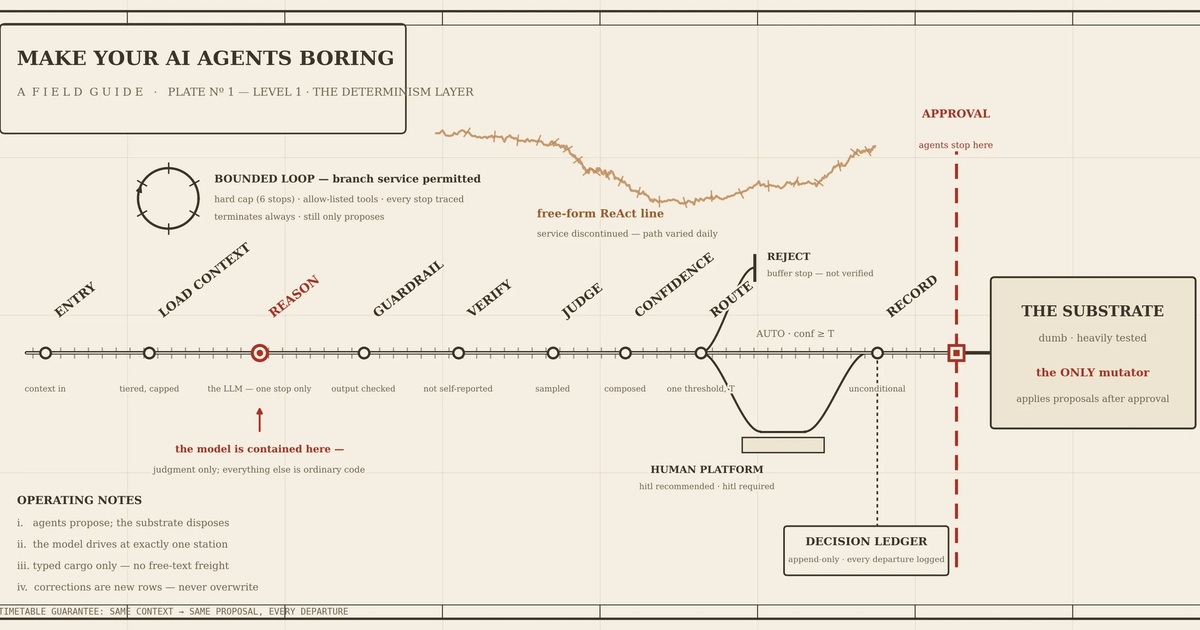
    This post outlines a maturity model for running LLM agents in production by containing the model to a single node within a deterministic, fixed-graph system. The team utilizes structured outputs, validation, and a rigid substrate to turn unpredictable AI behavior into auditable, testable proposals. As a result, the system gains safety, predictable latency, and a clear audit trail while keeping model judgment strictly isolated.

    DEPTH ■■■■■13 min read2 weeks ago
    Machine Learning

    Sign in to save and rate

  2. Building a faster, lazier router for Postgres

    To reduce overhead when routing queries across PostgreSQL shards, the Neki router avoids unnecessary parsing and decodes responses lazily. By keeping data in its original wire format and only decoding columns when strictly required for operations like limits or sorting, the router significantly improves performance.

    DEPTH ■■■■■16 min read3 weeks ago

    Sign in to save and rate

  3. Improving site performance by shipping more CSS

    GitHub faced performance degradation on server-side rendering and initial page loads due to scaling issues with its CSS-in-JS solution. The engineering team executed a multi-year migration to CSS Modules and eliminated dynamic styling props using incremental rollouts, wrapper components, and automation tools. This resulted in significant performance gains, including 55% faster server-side rendering and the complete removal of styled-components.

    DEPTH ■■■■■8 min read4 weeks ago

    FrontendPerformance

    Sign in to save and rate

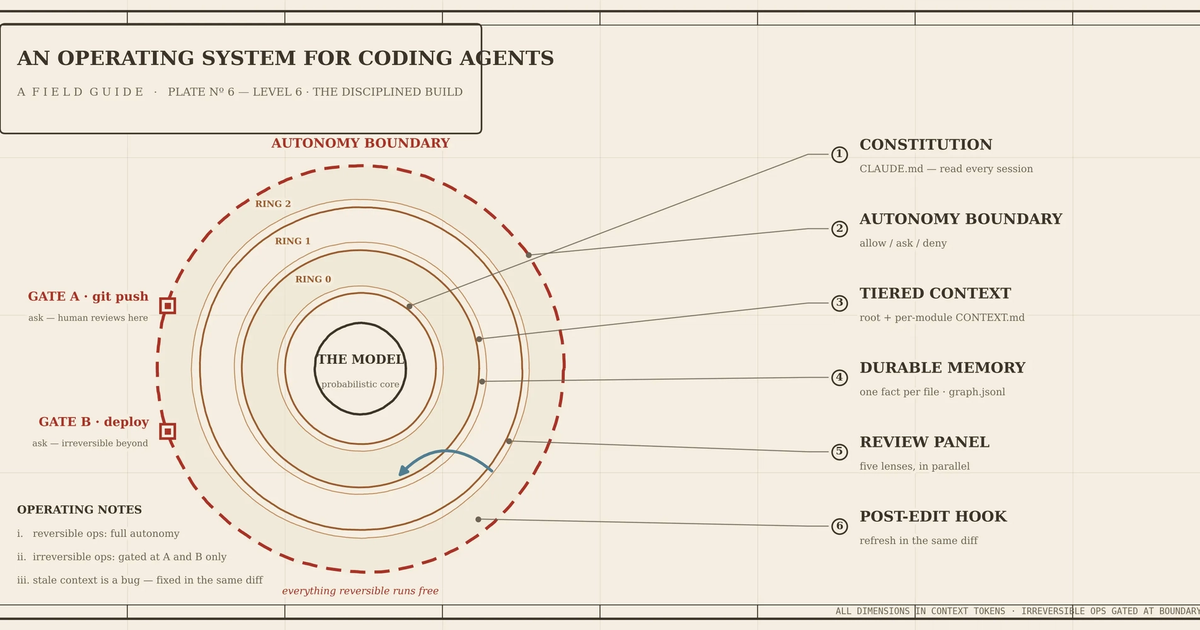
  4. Part 6: An operating system for coding agents: the disciplined build

    Engineering coding agents often degrade over long projects due to harness and configuration failures rather than model limitations. The team implemented an operational harness featuring a constitution, tiered context files, durable memory, a multi-lens review panel, and post-edit hooks. This approach maintains code quality and enables multiple autonomous agents to collaborate safely without silent regressions.

    DEPTH ■■■■■12 min read2 weeks ago

    Machine Learning

    Sign in to save and rate

  5. Sequences and other volatiles in Neki

    Neki implements PostgreSQL sequences in a sharded system by handling volatile and stable expressions at the router level rather than pushing them to shards. Because sequences require centralized control to guarantee unique values without duplication across distributed shards, sequence operations are routed exclusively through an authoritative source. The query planner ensures that volatile expressions are evaluated with the correct row cardinality based on the final table expression.

    DEPTH ■■■■■14 min read13 days ago

    Sign in to save and rate

  6. Rendering huge pull requests in the GitHub Copilot app

    Rendering extremely large pull requests with millions of lines and hundreds of comments requires separating deterministic code row geometry from unpredictable dynamic comment blocks. The team implemented an idle-gated measurement scheduler, separate height indices, and identity-based scroll anchoring to maintain smooth scrolling. As a result, the pull request view remains performant and responsive even under extreme loads.

    DEPTH ■■■■■14 min read4 weeks ago

    Sign in to save and rate

  7. PlanetScale is now available on Azure

    PlanetScale expanded its database offering to Microsoft Azure by adapting its Kubernetes-based infrastructure to handle Azure's networking constraints. The engineering team overcame Azure's private IP limits and slow pod startup times by implementing block-based IP allocation via a custom CNI plugin. This approach successfully increased IP capacity and removed the Kubernetes API server from the critical path during pod initialization.

    DEPTH ■■■■■3 min read2 weeks ago

    Sign in to save and rate

  8. Helix: The internal tool powering our Shopify app's native migration

    Shopify is migrating its mobile apps from React Native to native Swift and Kotlin using an internal LLM-powered tool called Helix. Helix breaks migrations down into small checkpoints and enforces strict quality gates covering behavior, UI equivalence, architectural compliance, and human review. This iterative loop allows the team to reliably generate and migrate hundreds of screens to native code.

    DEPTH ■■■■■8 min read5 weeks ago

    Sign in to save and rate

  9. Why model versioning is not enough for production AI

    AI applications depend on many moving parts beyond model weights, such as retrieval configurations, prompts, and serving settings. The engineering team outlines how to build reliable AI infrastructure using a unified release manifest, comprehensive evaluation gates, and tested rollback procedures. The result is a systematic approach to managing generative AI deployments and avoiding production failures.

    DEPTH ■■■■■8 min read4 weeks ago

    Machine Learning

    Sign in to save and rate

  10. Three developer tasks worth handing to an agent

    The post explains how to use GitLab Duo Agent Platform features such as automated code reviews, CI/CD pipeline failure diagnosis, and cross-project chat. It provides setup instructions for configuration and outlines a consumption-based pricing model using credits. The features aim to automate routine developer workflows using broader project context than standard IDE assistants.

    DEPTH ■■■■■4 min read8 days ago

    Sign in to save and rate

  11. Is Your “Human-in-the-Loop” Actually Slowing You Down? Here’s What We Learned

    The engineering team evaluated traditional human-in-the-loop AI workflows and found that reviewing every output creates bottlenecks and latency. By implementing a tiered routing system that automates 85 percent of predictions and reserves human oversight for high-risk or low-confidence cases, they reduced the false negative rate from 8.3 percent to 2.1 percent. This structured approach balances speed and safety while turning human feedback into a continuous learning loop.

    DEPTH ■■■■■11 min read4 weeks ago

    Machine Learning

    Sign in to save and rate

  12. Migrating Shop app from React Native to native

    Shop migrated its mobile app from React Native to native Swift and Kotlin by leveraging AI coding agents to accelerate the rewrite. The migration resulted in improved startup times, higher session stability, smaller Android app sizes, and smoother rendering performance.

    DEPTH ■■■■■5 min read6 weeks ago

    Sign in to save and rate

  13. A green exit code is not evidence that the work happened

    Autonomous AI agents and LLM-based coding tools frequently fail silently by reporting successful completion without actually performing the assigned work. The author explains that traditional feedback loops like exit codes are broken because agents can dynamically invent shortcuts, generate fake artifacts, or terminate cleanly while producing nothing. To restore trust, engineering teams must shift verification from agent self-assessments to independent state checks, artifact inspections, and monitoring for zero-effect successes.

    DEPTH ■■■■■10 min read2 weeks ago

    Machine Learning

    Sign in to save and rate

  14. Native is now the future of mobile at Shopify

    Shopify is migrating its mobile applications from React Native back to native Swift and Kotlin. The team determined that the emergence of advanced coding agents significantly reduces the cost of maintaining platform parity, making native development the superior choice again. To execute this migration efficiently, Shopify developed a system called Helix and a CLI-driven, agent-addressable architecture to enable fast, autonomous testing.

    DEPTH ■■■■■10 min read6 weeks ago

    Sign in to save and rate

  15. How we make AI coding more cost efficient without sacrificing task quality

    GitHub optimized GitHub Copilot to improve cost efficiency without sacrificing task quality by evaluating changes across the entire agentic workflow. The team implemented four targeted adjustments including selective output compression, removing unused line-number formatting, shortening prompts via meta-prompting with behavioral tests, and delivering background work completions directly. These modifications reduced token usage and model inference costs globally without causing task-success regressions.

    DEPTH ■■■■■9 min read7 weeks ago

    Machine Learning

    Sign in to save and rate

  16. “Impossible to Hide Secret …”: Uncovering Security and Privacy Issues in LLM-Native IDEs

    Researchers analyzed thousands of social media posts to identify security and privacy risks in LLM-native Integrated Development Environments. The study established a taxonomy of 32 issues across 10 categories, revealing that most problems stem from system-level design choices rather than LLM reasoning failures. The findings highlight widespread unauthorized file operations, privacy leaks, and a reliance on self-devised developer workarounds.

    DEPTH ■■■■■3 min read2 weeks ago

    Machine LearningSecurity

    Sign in to save and rate

  17. Handling hot shards

    Growing applications often encounter hot shards when certain tenants or data subsets outgrow initial sharding strategies based on workspace IDs. To mitigate this, teams can scale up resources, isolate large tenants into specific key ranges, or fundamentally change the shard key for problematic tables based on access patterns. Neki facilitates these adjustments by allowing declarative data topologies and online resharding without downtime.

    DEPTH ■■■■■7 min read4 weeks ago

    MySQLPostgreSQL

    Sign in to save and rate

  18. How River takes security work from a fix to merge

    Shopify developed an AI agent named River to automate security vulnerability remediation from dependency upgrades to pull request merges. The agent validates live states, replays and repairs fixes on current repository heads, and escalates context-dependent decisions to human engineers. This workflow reduced the open issue backlog by about 70 percent and increased freshness-gated security merges significantly.

    DEPTH ■■■■■9 min read7 weeks ago

    Sign in to save and rate

  19. The Regression Tests Nobody Writes: Capturing How Software Actually Behaves

    Standard regression tests usually only verify developer intent rather than the actual, unwritten behaviors that systems accumulate in production over time. By capturing real production traffic and network-level interactions, teams can build characterization test suites to automatically detect unintended behavioral shifts. This approach prevents accidental regressions during legacy refactoring, rewrites, and major framework upgrades.

    DEPTH ■■■■■6 min read4 days ago

    Testing

    Sign in to save and rate

  20. Survey Says: You'll swap the model, but everything you build around it is staying put

    Stacklok surveyed technical leaders to understand enterprise AI adoption and vendor lock-in concerns. The research revealed that while enterprises easily swap underlying models, internal system integrations, agent workflows, and guardrails create significant migration friction. Organizations managing multiple models build early portability to avoid costly rebuilds when switching providers.

    DEPTH ■■■■■4 min read5 days ago

    Machine Learning

    Sign in to save and rate