/ THE FEED /

Read what ships.

Deep, recent reads ranked by depth and freshness.

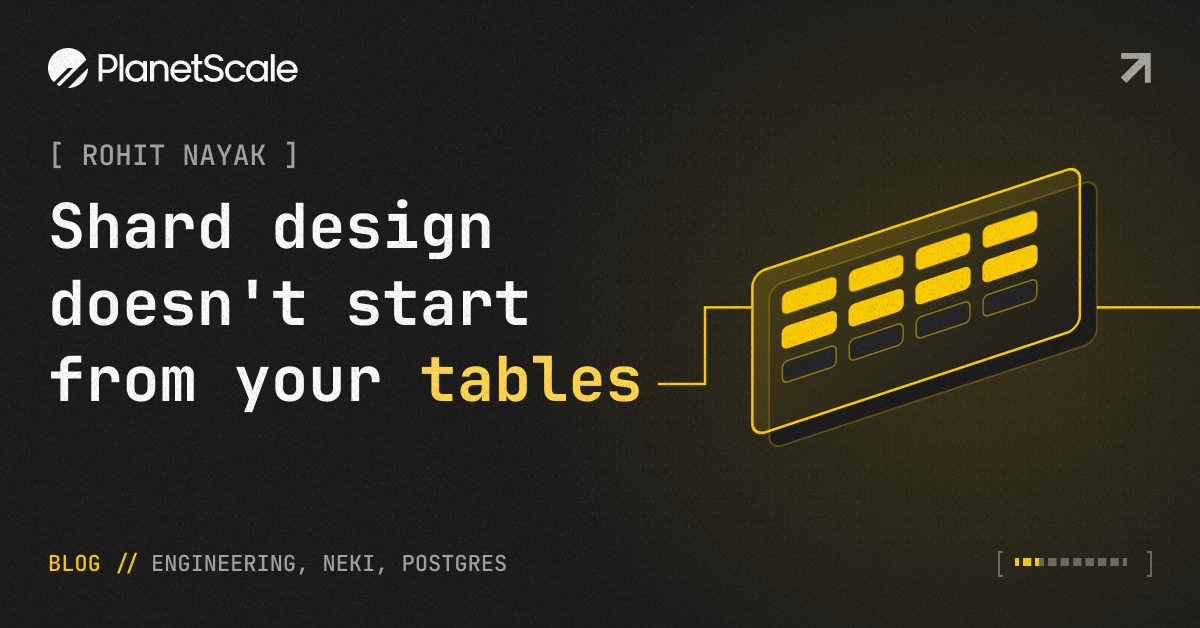
  1. Shard design doesn't start from your tables

    Designing a sharded Postgres architecture requires grouping tables around shared query keys rather than starting from table structures alone. The post details how to configure shard groups, reference tables, SQL expressions in shard indexes, and global secondary indexes using Neki. This setup enables efficient single-shard queries and transactions while maintaining full Postgres semantics.

    DEPTH ■■■■■8 min read2 days ago
    PostgreSQL

    Sign in to save and rate

  2. I don't trust ON DELETE CASCADE

    Postgres ON DELETE CASCADE can cause production outages, replication failures, and performance degradation during large deletions or schema migrations due to long-running transactions holding locks and generating massive WAL. The author recommends using soft deletes with batched background cleanup instead to keep transactions short and bounded. This approach avoids table locks and simplifies data recovery.

    DEPTH ■■■■■5 min read4 days ago

    PostgreSQL

    Sign in to save and rate

  3. Evolving our calendar assistant Reclaim to be AI-native without starting over

    Dropbox engineers evolved their calendar assistant, Reclaim, to support natural-language AI requests by building a custom agent platform that integrates with existing scheduling logic. They utilized a shared action system and a Preview Mode backed by Redis to ensure AI suggestions are consistent and reviewable before affecting real calendars. This approach allows the product to adopt AI capabilities without fragmenting its core architecture or duplicating functionality.

    DEPTH ■■■■■7 min read3 weeks ago

    InfrastructureMachine Learning

    Sign in to save and rate

  4. What gets TOASTed in Postgres

    This post examines how PostgreSQL uses TOAST to manage oversized rows and variable-length columns through compression and off-row storage. It compares the pglz and LZ4 compression algorithms across different workloads, highlighting trade-offs in search windows, file sizes, and CPU overhead. The analysis demonstrates how these mechanisms impact storage efficiency and read performance for large text and JSON data.

    DEPTH ■■■■■12 min read13 days ago

    PostgreSQL

    Sign in to save and rate

  5. TIN v1.0.6: 2-3x faster, with support for stemming

    Following competitive benchmarks that highlighted opportunities for optimization, the developers of the TIN full-text search index for Postgres released versions 1.0.4 and 1.0.6. These updates added Snowball stemming for 18 languages, optimized top-k sorting queries with deterministic tiebreakers, and improved overall query performance. As a result, benchmark tests show that TIN outperforms competing extensions across conjunction, disjunction, and phrase query workloads.

    DEPTH ■■■■■8 min read2 weeks ago

    PostgreSQL

    Sign in to save and rate

  6. Building a faster, lazier router for Postgres

    To reduce overhead when routing queries across PostgreSQL shards, the Neki router avoids unnecessary parsing and decodes responses lazily. By keeping data in its original wire format and only decoding columns when strictly required for operations like limits or sorting, the router significantly improves performance.

    DEPTH ■■■■■16 min read3 weeks ago

    Sign in to save and rate

  7. Sequences and other volatiles in Neki

    Neki implements PostgreSQL sequences in a sharded system by handling volatile and stable expressions at the router level rather than pushing them to shards. Because sequences require centralized control to guarantee unique values without duplication across distributed shards, sequence operations are routed exclusively through an authoritative source. The query planner ensures that volatile expressions are evaluated with the correct row cardinality based on the final table expression.

    DEPTH ■■■■■14 min read11 days ago

    Sign in to save and rate

  8. PlanetScale is now available on Azure

    PlanetScale expanded its database offering to Microsoft Azure by adapting its Kubernetes-based infrastructure to handle Azure's networking constraints. The engineering team overcame Azure's private IP limits and slow pod startup times by implementing block-based IP allocation via a custom CNI plugin. This approach successfully increased IP capacity and removed the Kubernetes API server from the critical path during pod initialization.

    DEPTH ■■■■■3 min read12 days ago

    Sign in to save and rate

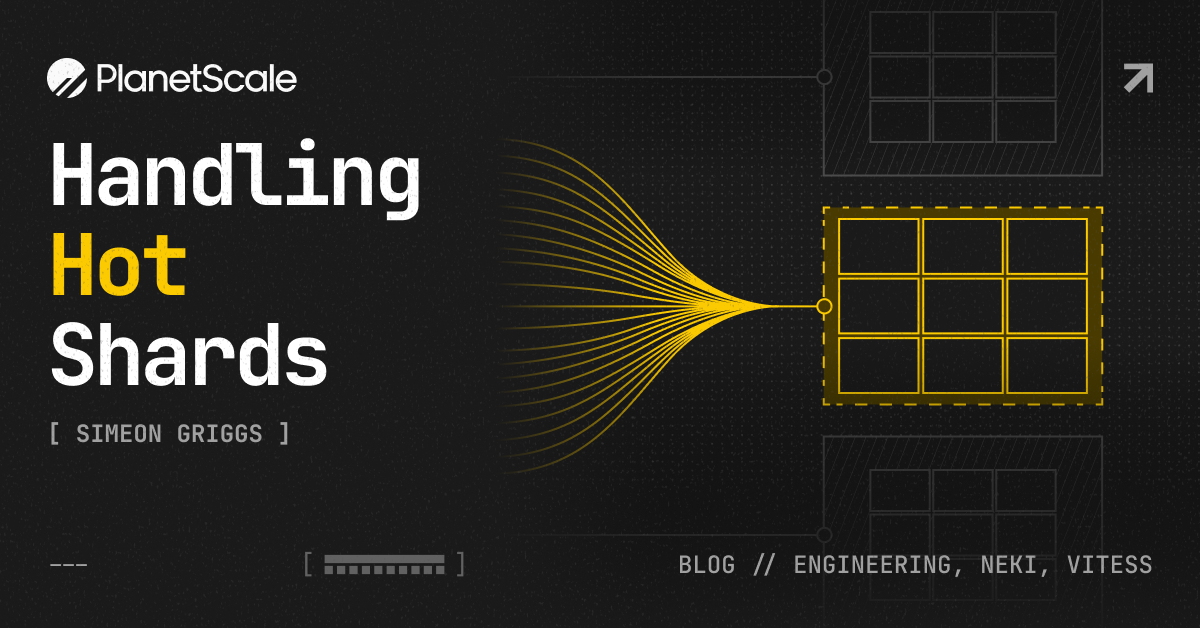
  9. Handling hot shards

    Growing applications often encounter hot shards when certain tenants or data subsets outgrow initial sharding strategies based on workspace IDs. To mitigate this, teams can scale up resources, isolate large tenants into specific key ranges, or fundamentally change the shard key for problematic tables based on access patterns. Neki facilitates these adjustments by allowing declarative data topologies and online resharding without downtime.

    DEPTH ■■■■■7 min read3 weeks ago

    MySQLPostgreSQL

    Sign in to save and rate