/ THE FEED /

Read what ships.

Deep, recent reads ranked by depth and freshness.

  1. Inside Hyperdrive: How we solved a rare Hyperdrive MySQL caching bug

    During the beta of MySQL support for Hyperdrive, engineers investigated rare empty query responses and connection hangs occurring in 0.001% of requests. They discovered that sharing the data center cache between client and endpoint nodes caused protocol capability mismatches when translating MySQL wire messages. The team resolved the issue by standardizing the cache to always store responses encoded with canonical Hyperdrive capabilities.

    DEPTH ■■■■■9 min read12 days ago

    MySQL

    Sign in to save and rate

  2. Stopping business email compromise with AI-driven email security: How VIPRE protects modern enterprises on AWS

    VIPRE developed an AI-driven, cloud-native email security solution on AWS to protect enterprises against business email compromise and advanced phishing attacks. The system uses layered machine learning, semantic analysis, and dynamic sandboxing orchestrated via serverless containers and message queues to evaluate over half a million messages daily. In production testing, the architecture successfully identified thousands of BEC attempts while maintaining low-latency processing and reducing administrative overhead.

    DEPTH ■■■■■12 min read13 days ago

    Sign in to save and rate

  3. Staying Evergreen: How we automated secure access and repo hygiene in a shared org

    Manual repository housekeeping and access reviews for outside collaborators become difficult to maintain as organizations scale. The team built Evergreen, a GitHub App that automates quarterly access reviews and stale repository archiving using native platform features and IssueOps. This automation successfully enforces secure defaults by revoking unanswered access while maintaining a full audit trail in git history.

    DEPTH ■■■■■8 min read11 days ago

    Sign in to save and rate

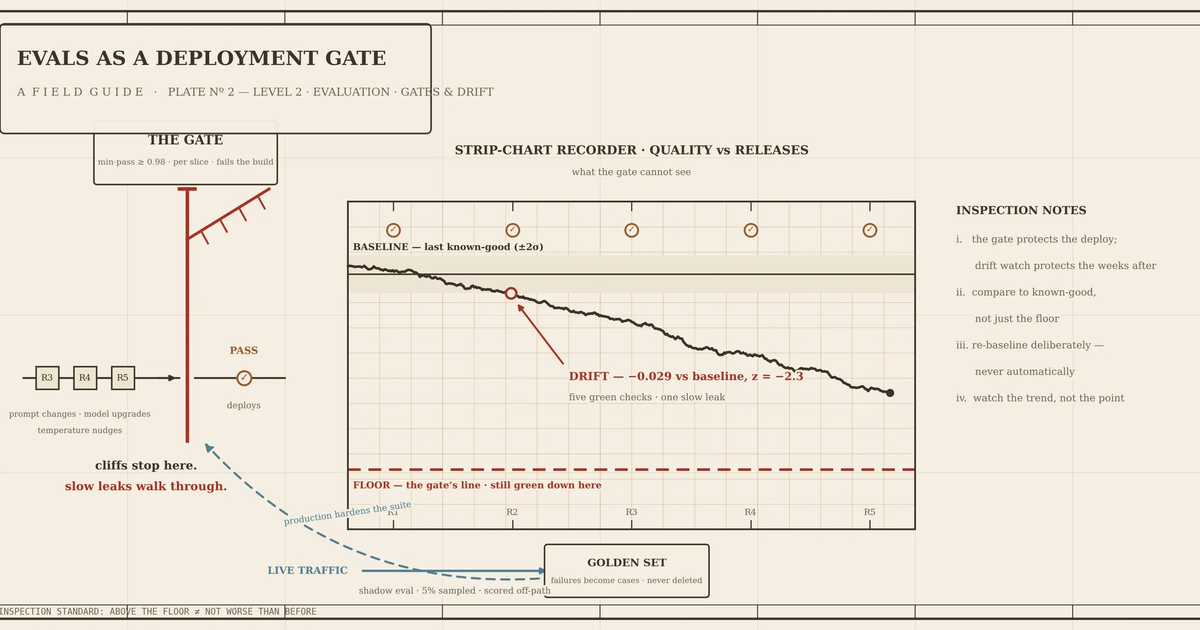
  4. Part 2: Evals as a deployment gate — and how to know when they drift

    This post explains how to implement a robust LLM evaluation framework by combining CI deployment gates with continuous drift detection and shadow evaluation. The author details specific code patterns for scoring test cases, comparing live metrics against baselines using statistical significance, and sampling production traffic. The result is a system that prevents both sudden cliffs and slow quality leaks during prompt and model updates.

    DEPTH ■■■■■8 min read2 weeks ago

    Machine Learning

    Sign in to save and rate

  5. Under the hood, off the hot path: How D1 scales to millions of databases

    Cloudflare scaled its serverless SQLite database, D1, to support millions of databases by decoupling the control plane from the data plane. The team used distributed metadata caching via Workers KV, optimized database connections through Hyperdrive, and implemented a self-correcting heartbeat mechanism. This architecture prevents centralized bottlenecks and allows D1 to handle rapid on-demand database creation efficiently.

    DEPTH ■■■■■22 min read13 days ago

    Databases

    Sign in to save and rate

  6. Bulk Executor for Amazon DynamoDB, Part 2: Lessons we learned the hard way

    Engineering a bulk execution tool for Amazon DynamoDB using AWS Glue required addressing several architectural challenges, including cost estimation, graceful job termination, and error handling across hundreds of parallel workers. The team overcame limitations in CloudWatch logging and the Spark connector by combining serverless execution with direct API calls and distributed rate limiting. As a result, the tool provides a scalable, script-like interface for managing large-scale table operations safely.

    DEPTH ■■■■■14 min read13 days ago

    Sign in to save and rate

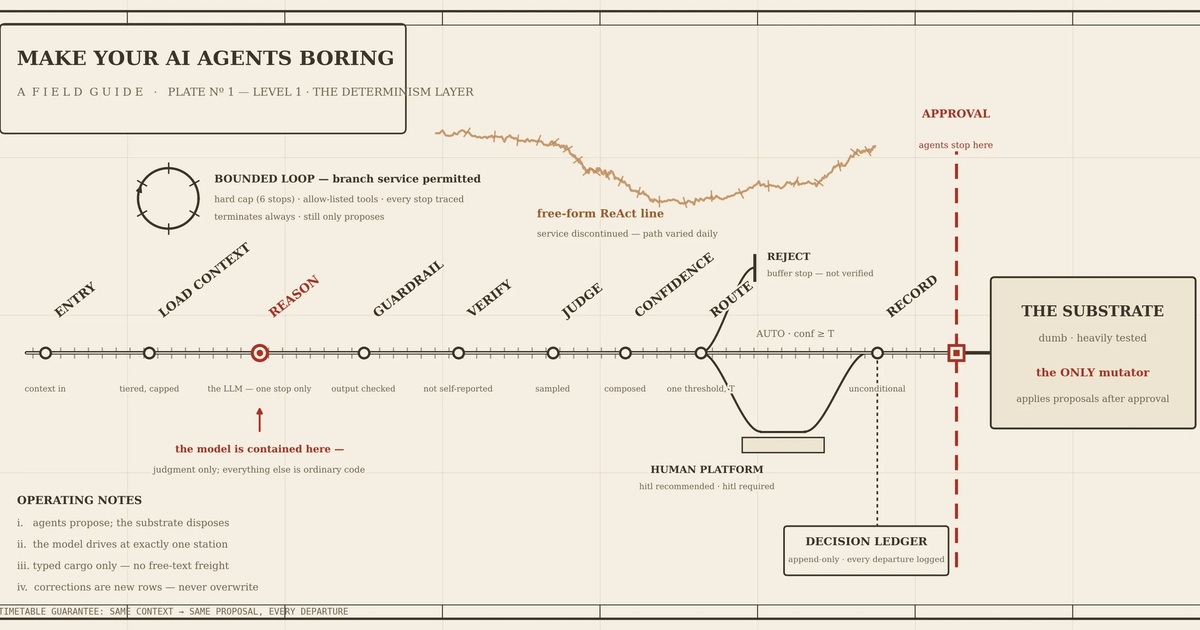
  7. Part 1: Make your AI agents boring: the determinism layer

    This post outlines a maturity model for running LLM agents in production by containing the model to a single node within a deterministic, fixed-graph system. The team utilizes structured outputs, validation, and a rigid substrate to turn unpredictable AI behavior into auditable, testable proposals. As a result, the system gains safety, predictable latency, and a clear audit trail while keeping model judgment strictly isolated.

    DEPTH ■■■■■13 min read2 weeks ago

    Machine Learning

    Sign in to save and rate

  8. Rewinding the exponential: How we keep hardware usage down

    Cloudflare tackled exponential traffic growth against linear hardware growth by continuously evolving their data pipeline architecture over five years. Key optimizations included breaking up monolithic schemas, switching to zstd compression, decoupling pipeline transit from database replication, decentralizing sampling, and moving aggregations earlier in the pipeline. These strategies significantly reduced backbone bandwidth usage, network congestion, and storage requirements while preserving data quality.

    DEPTH ■■■■■12 min read13 days ago

    Infrastructure

    Sign in to save and rate

  9. Unreal MCP now speaks Sentry

    The Sentry team integrated their crash reporting plugin with Unreal Engine's new experimental Model Context Protocol (MCP) server, allowing coding agents to fully automate setup and debugging. By combining editor tools and Sentry MCP, an agent successfully configured the SDK, uploaded debug symbols, packaged a build, induced a crash, and traced the root cause without manual file editing. The integration streamlines crash reporting setup, though it currently suffers from occasional agent tool-discovery issues and server fragility across editor restarts.

    DEPTH ■■■■■7 min read2 weeks ago

    Sign in to save and rate

  10. Agentic antimicrobial resistance surveillance with AWS HealthOmics and Amazon Bedrock AgentCore

    Processing public bacterial sequencing data for antimicrobial resistance surveillance typically requires specialized bioinformatics and SQL skills. To streamline this process, the team built a reference architecture using AWS HealthOmics, Amazon S3 Tables, and an Amazon Bedrock AgentCore conversational agent that ingests raw reads, normalizes findings, and answers plain-language questions with cited evidence. The resulting system automates the path from public accession numbers to natural-language epidemiological answers.

    DEPTH ■■■■■10 min read2 weeks ago

    Sign in to save and rate

  11. Improving site performance by shipping more CSS

    GitHub faced performance degradation on server-side rendering and initial page loads due to scaling issues with its CSS-in-JS solution. The engineering team executed a multi-year migration to CSS Modules and eliminated dynamic styling props using incremental rollouts, wrapper components, and automation tools. This resulted in significant performance gains, including 55% faster server-side rendering and the complete removal of styled-components.

    DEPTH ■■■■■8 min read4 weeks ago

    FrontendPerformance

    Sign in to save and rate

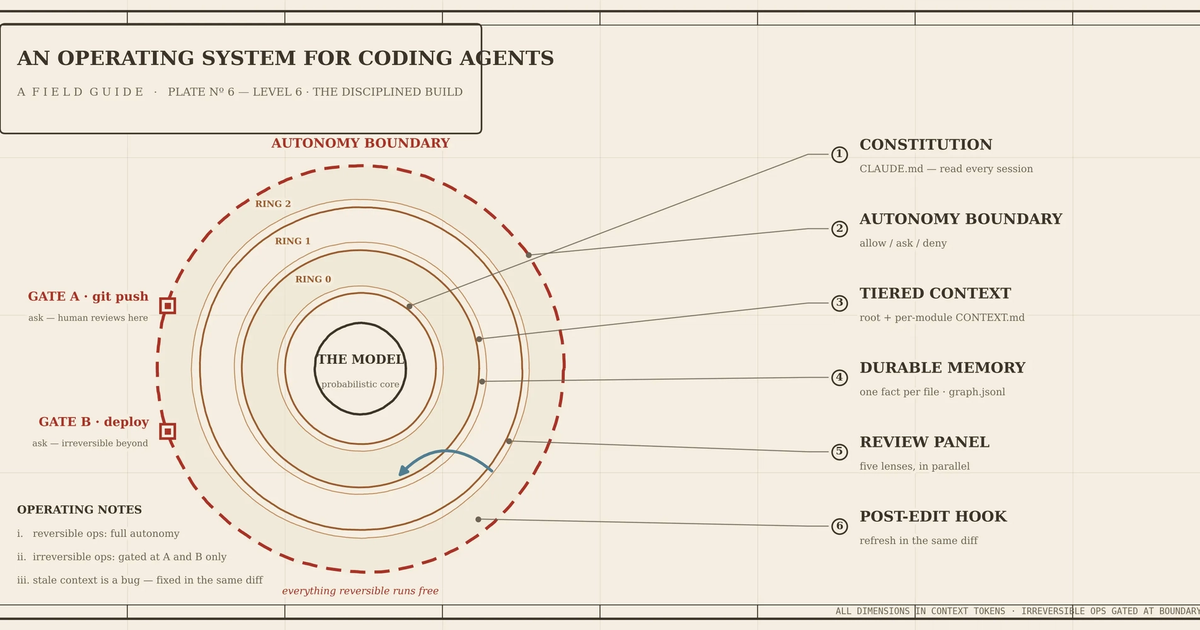
  12. Part 6: An operating system for coding agents: the disciplined build

    Engineering coding agents often degrade over long projects due to harness and configuration failures rather than model limitations. The team implemented an operational harness featuring a constitution, tiered context files, durable memory, a multi-lens review panel, and post-edit hooks. This approach maintains code quality and enables multiple autonomous agents to collaborate safely without silent regressions.

    DEPTH ■■■■■12 min read2 weeks ago

    Machine Learning

    Sign in to save and rate

  13. Filter, reshape, and redact logs before export with Transformers

    Cloudflare integrated SQL-based log transformation directly into its Logpush export pipeline, allowing customers to filter, redact, and reshape logs before delivery. The team chose to embed the Apache DataFusion engine in-process using Rust and Go across an Arrow IPC boundary to ensure high throughput and avoid network latency. As a result, the system processes high-volume log streams efficiently while maintaining predictable resource usage and strict delivery reliability.

    DEPTH ■■■■■8 min read2 weeks ago

    Sign in to save and rate

  14. Should you use a log or a metric?

    This post explains the distinction between logs and metrics in application monitoring, noting that logs capture what was true during specific events for debugging while metrics track ongoing numerical trends over time. The author demonstrates how to implement both using Sentry SDKs during a user signup flow and outlines criteria for choosing between them. The resulting takeaway helps engineers decide whether to log an event or track it as a metric based on the questions they need to answer.

    DEPTH ■■■■■12 min read4 days ago

    Sign in to save and rate

  15. Rendering huge pull requests in the GitHub Copilot app

    Rendering extremely large pull requests with millions of lines and hundreds of comments requires separating deterministic code row geometry from unpredictable dynamic comment blocks. The team implemented an idle-gated measurement scheduler, separate height indices, and identity-based scroll anchoring to maintain smooth scrolling. As a result, the pull request view remains performant and responsive even under extreme loads.

    DEPTH ■■■■■14 min read4 weeks ago

    Sign in to save and rate

  16. Deploy Oracle Database step by step on Amazon EVS with FSx for ONTAP

    This post provides a step-by-step guide to deploying Oracle Database 19c on Amazon Elastic VMware Service using Amazon FSx for NetApp ONTAP as an NFS datastore. It covers provisioning storage, mounting datastores, installing Oracle, configuring SnapMirror for cross-region disaster recovery, and outlining four migration paths. The result is a fully functional enterprise database deployment that preserves existing operational workflows.

    DEPTH ■■■■■11 min read3 weeks ago

    Sign in to save and rate

  17. Cloudflare deploys protections against php2shell vulnerability

    Recent disclosures revealed critical remote code execution and data exposure vulnerabilities in the PHP runtime. To mitigate the threat before public disclosure, Cloudflare developed full transaction detection to combine request and response signals within the WAF. This capability enabled automatic deployment of rules protecting customers against the php2shell exploits.

    DEPTH ■■■■■6 min read5 days ago

    Security

    Sign in to save and rate

  18. How Etsy gets its mobile apps ready for peak traffic

    Etsy prepares its mobile apps for peak holiday traffic through advance planning, operational guardrails, and risk management rather than relying on capacity scaling or the ability to quickly revert binaries. The engineering team utilizes a phased code slush, dual crash reporting, remote feature flags, and custom error tagging to surface and mitigate issues effectively under heavy loads. By connecting crash rates to business metrics and automating manual triage workflows incrementally, the organization maintains high visibility and reliability when updates cannot be instantly rolled back.

    DEPTH ■■■■■11 min read3 weeks ago

    Sign in to save and rate

  19. Why model versioning is not enough for production AI

    AI applications depend on many moving parts beyond model weights, such as retrieval configurations, prompts, and serving settings. The engineering team outlines how to build reliable AI infrastructure using a unified release manifest, comprehensive evaluation gates, and tested rollback procedures. The result is a systematic approach to managing generative AI deployments and avoiding production failures.

    DEPTH ■■■■■8 min read4 weeks ago

    Machine Learning

    Sign in to save and rate

  20. Three developer tasks worth handing to an agent

    The post explains how to use GitLab Duo Agent Platform features such as automated code reviews, CI/CD pipeline failure diagnosis, and cross-project chat. It provides setup instructions for configuration and outlines a consumption-based pricing model using credits. The features aim to automate routine developer workflows using broader project context than standard IDE assistants.

    DEPTH ■■■■■4 min read8 days ago

    Sign in to save and rate