/ THE FEED /

Read what ships.

Deep, recent reads ranked by depth and freshness.

  1. Beyond container image signing: How we enforce software supply chain policies at Datadog

    Container image signing alone cannot detect upstream security compromises occurring before the image is signed. To address this, the engineering team built an internal system called Turnstile that generates cryptographically signed attestations across an artifact's life cycle and evaluates them against environment-specific policies at deployment time. This approach enables the organization to enforce strict security and compliance requirements at scale without disrupting developer workflows.

    DEPTH ■■■■■15 min read5 days ago

    Sign in to save and rate

  2. OpenTelemetry Collector Configuration for LLM Observability

    LLM applications emit bulky telemetry containing sensitive user content and disparate attribute names. The team uses an OpenTelemetry Collector pipeline to normalize, enrich, redact, and export this data to Honeycomb. This centralizes control, protects data before it leaves the network, and maintains consistent observability.

    DEPTH ■■■■■12 min read2 weeks ago

    Sign in to save and rate

  3. Evolving our calendar assistant Reclaim to be AI-native without starting over

    Dropbox engineers evolved their calendar assistant, Reclaim, to support natural-language AI requests by building a custom agent platform that integrates with existing scheduling logic. They utilized a shared action system and a Preview Mode backed by Redis to ensure AI suggestions are consistent and reviewable before affecting real calendars. This approach allows the product to adopt AI capabilities without fragmenting its core architecture or duplicating functionality.

    DEPTH ■■■■■7 min read3 weeks ago

    InfrastructureMachine Learning

    Sign in to save and rate

  4. How we extended Apache DataFusion to execute one query across many machines

    Datadog needed to execute interactive queries across large datasets that exceeded single-node limits while maintaining low latency. To solve this, the team built Distributed DataFusion, an open-source framework extending Apache DataFusion across multiple machines using zero-copy streaming via Apache Arrow and Substrait. As a result, heavy queries complete up to 10 times faster without imposing distribution overhead on lightweight queries.

    DEPTH ■■■■■12 min read3 weeks ago

    Sign in to save and rate

  5. How we built an async-aware Python profiler

    Traditional Python profilers treat asyncio tasks as independent stacks, obscuring logical execution paths and relationships. The Datadog team built an async-aware profiling model that tracks task dependencies to reconstruct unified execution paths ("stacked stacks") while reducing profiling overhead by over 60 percent. This approach provides clearer performance visibility for asynchronous applications without excessive production latency.

    DEPTH ■■■■■19 min read3 weeks ago

    Sign in to save and rate

  6. How Honeycomb Private Cloud Drinks From the Fire Hose

    The Honeycomb Private Cloud team struggled to manually track and integrate rapid infrastructure and configuration changes produced by upstream teams. To solve this, they built custom scripts to generate automated drift reports and eventually integrated AI to help triage and track the necessary follow-up work. As a result, the team successfully scaled their integration process into a reliable daily workflow.

    DEPTH ■■■■■10 min read2 weeks ago

    Sign in to save and rate

  7. Our Limits Are Not Our Imagination

    Software development practices are shifting as artificial intelligence makes advanced rigor, such as formal verification and property-based testing, an affordable default for greenfield projects. Developers can leverage AI agents to thoroughly review code and enforce strict architectural boundaries rather than just writing code faster. However, successful outcomes require comprehensive development systems and thinking rather than relying on AI alone.

    DEPTH ■■■■■3 min read5 days ago

    Sign in to save and rate

  8. Making Rust observability reliable at scale with OpenTelemetry

    Datadog engineers faced inconsistent tracing, broken spans, and context loss across Rust services due to fragmented tooling and unopinionated OpenTelemetry configurations. To fix this, they contributed upstream to OpenTelemetry to improve interoperability and built an opinionated Rust tracing library called dd-trace-rs. This reduced backend ingestion volume by 20x while increasing the rate of indexed spans per service by 3x.

    DEPTH ■■■■■10 min read7 weeks ago

    Sign in to save and rate

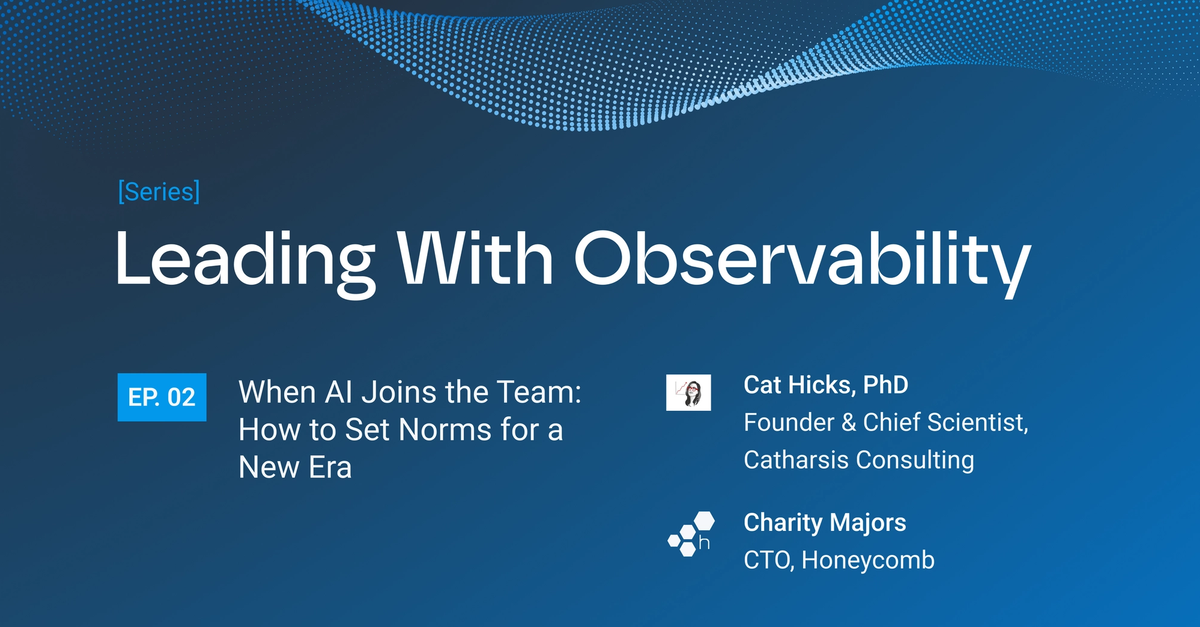
  9. Dr. Cat Hicks on the Psychology of Software Teams

    Engineering leaders must establish clear structures and cultural norms to reduce the psychological identity threat and anxiety developers experience when adopting AI tools. Research indicates that organizational trust regarding AI is currently fractured but repairable through realigned expectations and accountability. Furthermore, engineers are advised to build durable sources of professional identity rather than relying solely on mastery of specific languages or legacy codebases.

    DEPTH ■■■■■3 min read3 weeks ago

    Sign in to save and rate