/ THE FEED /

Read what ships.

Deep, recent reads ranked by depth and freshness.

  1. Rendering huge pull requests in the GitHub Copilot app

    Rendering extremely large pull requests with millions of lines and hundreds of comments requires separating deterministic code row geometry from unpredictable dynamic comment blocks. The team implemented an idle-gated measurement scheduler, separate height indices, and identity-based scroll anchoring to maintain smooth scrolling. As a result, the pull request view remains performant and responsive even under extreme loads.

    DEPTH ■■■■■14 min read4 weeks ago

    Sign in to save and rate

  2. PlanetScale is now available on Azure

    PlanetScale expanded its database offering to Microsoft Azure by adapting its Kubernetes-based infrastructure to handle Azure's networking constraints. The engineering team overcame Azure's private IP limits and slow pod startup times by implementing block-based IP allocation via a custom CNI plugin. This approach successfully increased IP capacity and removed the Kubernetes API server from the critical path during pod initialization.

    DEPTH ■■■■■3 min read2 weeks ago

    Sign in to save and rate

  3. Deploy Oracle Database step by step on Amazon EVS with FSx for ONTAP

    This post provides a step-by-step guide to deploying Oracle Database 19c on Amazon Elastic VMware Service using Amazon FSx for NetApp ONTAP as an NFS datastore. It covers provisioning storage, mounting datastores, installing Oracle, configuring SnapMirror for cross-region disaster recovery, and outlining four migration paths. The result is a fully functional enterprise database deployment that preserves existing operational workflows.

    DEPTH ■■■■■11 min read3 weeks ago

    Sign in to save and rate

  4. Three developer tasks worth handing to an agent

    The post explains how to use GitLab Duo Agent Platform features such as automated code reviews, CI/CD pipeline failure diagnosis, and cross-project chat. It provides setup instructions for configuration and outlines a consumption-based pricing model using credits. The features aim to automate routine developer workflows using broader project context than standard IDE assistants.

    DEPTH ■■■■■4 min read8 days ago

    Sign in to save and rate

  5. Architect highly available Oracle Database on Amazon EVS and FSx for ONTAP

    Enterprises migrating Oracle databases to Amazon Elastic VMware Service face challenges with storage latency, disaster recovery, and operational consistency. The team designed a highly available architecture combining Amazon EVS bare metal instances with Amazon FSx for NetApp ONTAP NFS datastores and cross-region SnapMirror replication. The resulting setup delivers sub-millisecond storage latency, preserved VMware operational workflows, and robust disaster recovery capabilities.

    DEPTH ■■■■■12 min read3 weeks ago

    Sign in to save and rate

  6. Deploy open source Regional availability tools in your VPC

    Engineering teams planning multi-Region architectures often struggle with evaluating AWS service availability and managing compliance risks. The team built and open-sourced two VPC-hosted solutions that deploy an automated Regional availability dashboard and a workload analysis pipeline using CloudTrail and CloudFormation. This setup allows organizations to securely filter and inspect the 20 to 30 services they actually use instead of hundreds.

    DEPTH ■■■■■13 min read3 weeks ago

    Sign in to save and rate

  7. Accelerating airline retailing innovation: how Datalex modernized with AWS Experience-Based Acceleration and agentic AI

    Datalex partnered with AWS for a three-day Experience-Based Acceleration workshop to modernize its mission-critical airline retail platform from Java 8 and EJB2 to Spring Boot on Java 21. The team used parallel workstreams and agentic AI to prove migration feasibility, implement automated CI/CD pipelines, and integrate generative AI capabilities without disrupting existing airline operations. This effort successfully established repeatable migration patterns, reduced memory usage by 35%, and accelerated the timeline for long-term platform evolution.

    DEPTH ■■■■■14 min read3 weeks ago

    Sign in to save and rate

  8. How we make AI coding more cost efficient without sacrificing task quality

    GitHub optimized GitHub Copilot to improve cost efficiency without sacrificing task quality by evaluating changes across the entire agentic workflow. The team implemented four targeted adjustments including selective output compression, removing unused line-number formatting, shortening prompts via meta-prompting with behavioral tests, and delivering background work completions directly. These modifications reduced token usage and model inference costs globally without causing task-success regressions.

    DEPTH ■■■■■9 min read7 weeks ago

    Machine Learning

    Sign in to save and rate

  9. Running multi-day AZ evacuation drills with ARC Zonal Shift

    This post explains how to run multi-day Availability Zone evacuation drills using ARC Zonal Shift to prove application resilience under sustained stress. The team details step-by-step procedures across ECS, EKS, and PostgreSQL databases to uncover hidden failure modes like unoptimized scaling and stale connections. The result is a practical framework for moving from theoretical multi-AZ architectures to proven operational resilience.

    DEPTH ■■■■■19 min read3 weeks ago

    Sign in to save and rate

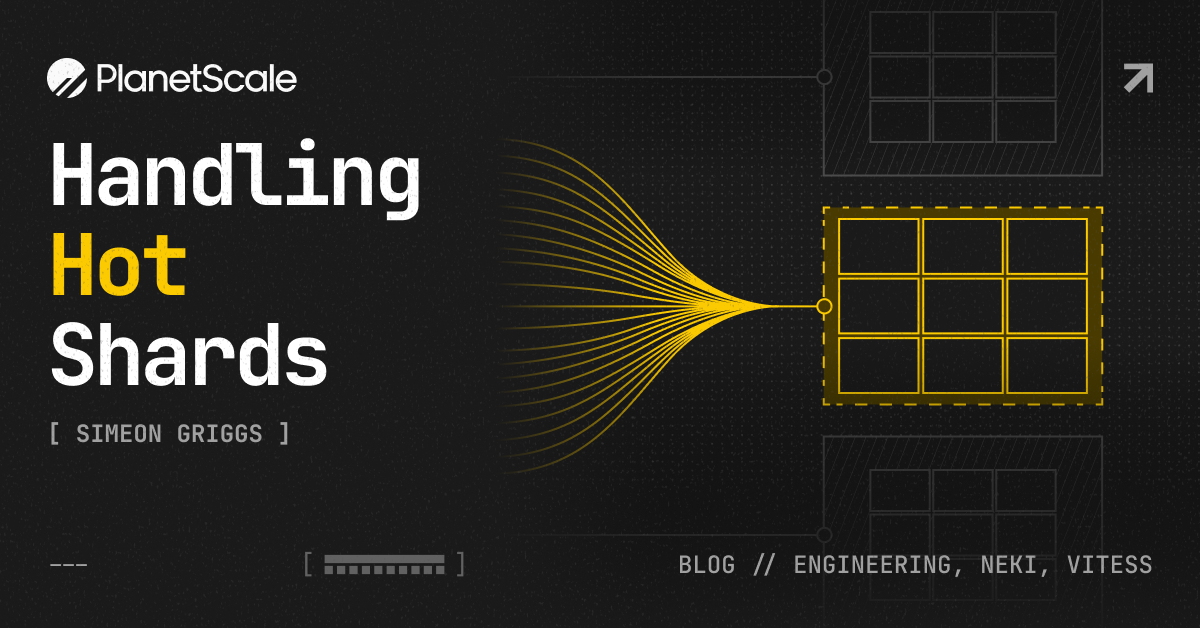
  10. Handling hot shards

    Growing applications often encounter hot shards when certain tenants or data subsets outgrow initial sharding strategies based on workspace IDs. To mitigate this, teams can scale up resources, isolate large tenants into specific key ranges, or fundamentally change the shard key for problematic tables based on access patterns. Neki facilitates these adjustments by allowing declarative data topologies and online resharding without downtime.

    DEPTH ■■■■■7 min read4 weeks ago

    MySQLPostgreSQL

    Sign in to save and rate

  11. How MHK built a HIPAA-eligible agentic AI solution on Amazon Bedrock

    Healthcare technology company MHK faced fragmented AI infrastructure and lengthy development cycles while trying to process unstructured medical documents under strict HIPAA standards. To solve this, they built a multi-tenant, event-driven agentic workflow framework called the SmartProminence AI Orchestrator on AWS using Amazon Bedrock, ECS, and SQS. The new system reduced manual review effort by 90% and shortened AI feature deployment times from months to weeks.

    DEPTH ■■■■■12 min read3 weeks ago

    Sign in to save and rate

  12. Build adaptive AI interfaces with the AG-UI protocol, agent swarms, and Nova Act on AWS

    AI applications produce variable outputs that cannot be effectively handled by static user interfaces, leading to development friction and poor user experiences. The team implemented an adaptive interface pattern using the AG-UI protocol, the Strands Agents SDK Swarm pattern, and Amazon Nova Act on AWS to dynamically render components and automate legacy integrations. This architecture streams agent findings over Server-Sent Events, enabling real-time multi-agent consensus and reducing interface development overhead.

    DEPTH ■■■■■22 min read3 weeks ago

    Sign in to save and rate

  13. How Dynata scaled AI across the development lifecycle with AI-DLC and Kiro IDE

    Dynata adopted the AI-Driven Development Lifecycle methodology using Kiro IDE and Amazon Q Developer to compress multi-sprint feature delivery into a single sprint. The team progressed from code generation to integrating knowledge ecosystems and conducting structured three-day feature workshops. As a result, requirements ambiguities surfaced early during planning and the team achieved faster, more aligned feature delivery.

    DEPTH ■■■■■15 min read11 days ago

    Sign in to save and rate