/ READING LIST /

Performance work and big migrations

What was slow and how it got fast, and how teams moved huge systems without stopping them. Measured, specific and detailed: depth 4 and up.

  1. Why Shopify Migrated From React Native

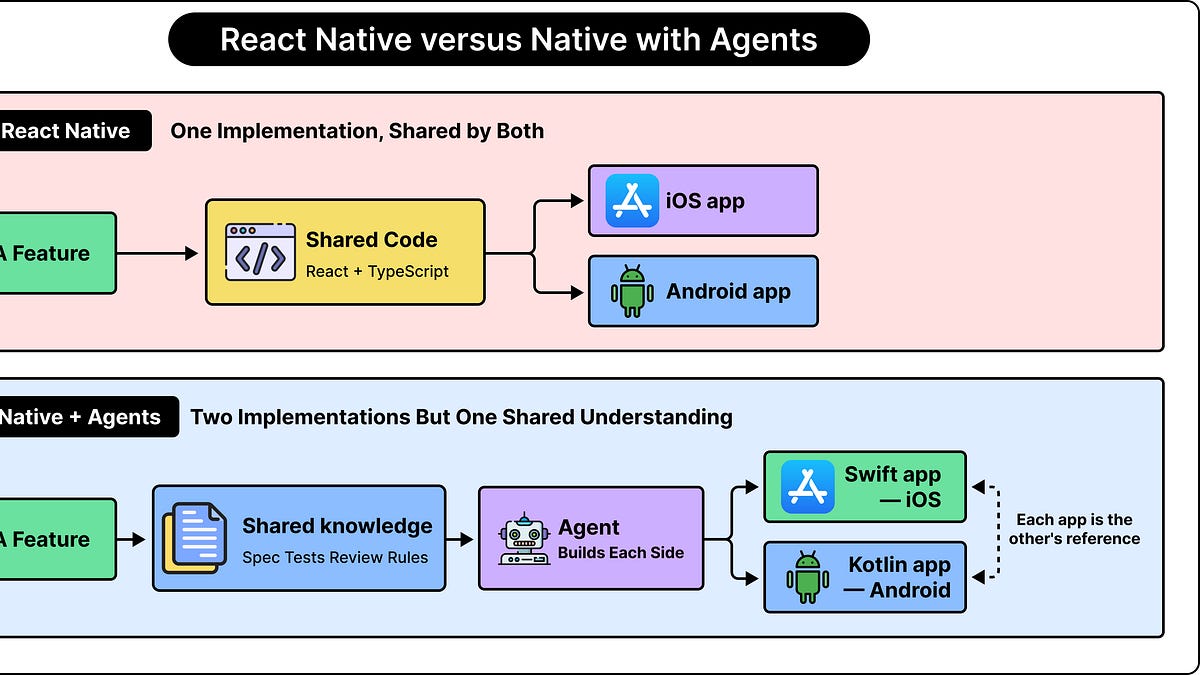
    Shopify migrated its mobile applications from React Native to native Swift and Kotlin because AI coding agents made the cost of duplicating features across platforms negligible. Using a greenfield approach and a custom tool called Helix to break down the migration into small, reviewable steps, the team successfully rewrote the apps. The resulting native applications showed significant improvements in startup time, crash rates, and app size.

    DEPTH ■■■■■11 min read5 days ago
    Sign in to save and rate

  2. Cutting our inference bill by 68% by being obsessive about optimization

    An engineering team investigated a steady rise in AI code review costs and found that cache misses and redundant model calls were driving up expenses. By restructuring system prompts to enable cross-repository prompt caching, eliminating wasted tool calls, and switching to more efficient models, the team cut inference costs by 68% while also significantly improving review latency.

    DEPTH ■■■■■15 min read5 days ago

    Machine Learning

    Sign in to save and rate

  3. Better HTTP/1 connection reuse

    Failing to read an HTTP/1 response body completely prevents connection reuse, forcing clients to repeatedly pay the high cost of TCP and TLS handshakes. While developers previously had to implement complex manual body-draining logic, Go 1.27 introduces automatic asynchronous response draining in the net/http package. This improvement allows developers to simply close response bodies without worrying about connection pooling performance.

    DEPTH ■■■■■7 min read11 days ago

    Sign in to save and rate

  4. Are Harnesses Worth the Cost?

    An experiment was conducted to evaluate whether behavioral harnesses improve coding agent reliability when building a complex backend-for-frontend service. While frontier models succeeded consistently with or without a harness, the harness significantly increased token usage, time, and cost without improving final output. However, for a cost-optimized model, the harness improved success rates from 30 percent to 100 percent.

    DEPTH ■■■■■17 min read12 days ago

    Sign in to save and rate

  5. SBD: We Have a Filesystem at Home

    Fly.io replaced a custom JuiceFS-based filesystem for their Sprites infrastructure with the Sprites Block Device (SBD) to eliminate complex, out-of-sync metadata ledgers. SBD presents object storage as a block device over NBD, allowing standard ext4 to manage the filesystem and simplifying checkpoints and restores. The result is significantly improved reliability and a much simpler storage architecture.

    DEPTH ■■■■■6 min read3 days ago

    Sign in to save and rate

  6. Yandex outage: Data shows that instead of going dark, malicious bots went on the move

    Following physical strikes on Yandex data centers, overall HTTP traffic from the network dropped significantly, leading to speculation that malicious bot farms had been disabled. However, traffic analysis revealed that search crawling simply decreased while malicious automation quickly migrated to other hosting providers with identical fingerprints. Consequently, overall malicious bot traffic remained flat, demonstrating that network disruptions do not stop portable automated workloads.

    DEPTH ■■■■■8 min read10 days ago

    Incidents & Postmortems

    Sign in to save and rate

  7. Reducing Android scope-sync overhead in Sentry Flutter

    The Sentry Flutter team investigated scope-sync overhead on Android and found redundant data normalization across isolates alongside unnecessary buffer copies during JSON encoding. By removing the duplicate normalization and encoding directly to UTF-8 bytes, the team reduced processing time by 27 to 30 percent across benchmarked payloads.

    DEPTH ■■■■■4 min read2 weeks ago

    Sign in to save and rate

  8. TIN v1.0.6: 2-3x faster, with support for stemming

    Following competitive benchmarks that highlighted opportunities for optimization, the developers of the TIN full-text search index for Postgres released versions 1.0.4 and 1.0.6. These updates added Snowball stemming for 18 languages, optimized top-k sorting queries with deterministic tiebreakers, and improved overall query performance. As a result, benchmark tests show that TIN outperforms competing extensions across conjunction, disjunction, and phrase query workloads.

    DEPTH ■■■■■8 min read2 weeks ago

    PostgreSQL

    Sign in to save and rate

  9. The Shift to cgroup v2 in Kubernetes: What You Need to Know

    Kubernetes has deprecated cgroup v1 in favor of cgroup v2, with complete removal scheduled for future releases. The transition requires migrating Linux nodes, updating container runtimes, and verifying kernel compatibility. Adopting cgroup v2 enables advanced features such as Memory QoS, improved OOM handling, and pressure stall information metrics.

    DEPTH ■■■■■12 min read2 weeks ago

    Sign in to save and rate

  10. Accelerating airline retailing innovation: how Datalex modernized with AWS Experience-Based Acceleration and agentic AI

    Datalex partnered with AWS for a three-day Experience-Based Acceleration workshop to modernize its mission-critical airline retail platform from Java 8 and EJB2 to Spring Boot on Java 21. The team used parallel workstreams and agentic AI to prove migration feasibility, implement automated CI/CD pipelines, and integrate generative AI capabilities without disrupting existing airline operations. This effort successfully established repeatable migration patterns, reduced memory usage by 35%, and accelerated the timeline for long-term platform evolution.

    DEPTH ■■■■■14 min read3 weeks ago

    Sign in to save and rate

  11. The Sentry Android SDK is now 20-30% faster!

    The Sentry team optimized the Android SDK to reduce initialization time by 20-30% and background CPU usage by up to 10%. Improvements were achieved by profiling with Perfetto, replacing slow runtime manifest parsing and DSN parsing with build-time bytecode writing and lightweight parsers, and reusing thread pools. Upgrading to the latest SDK version allows applications to realize these startup performance gains.

    DEPTH ■■■■■4 min read5 days ago

    Sign in to save and rate

  12. Shipping Media Over QUIC at Meta Scale for Instagram Live Ingest

    Meta deployed the emerging Media over QUIC (MoQ) protocol for Instagram Live ingest on iOS and Android to replace their legacy RUSH protocol. By using edge translation to avoid backend rewrites and a phased rollout strategy, the team achieved metric parity with the old protocol without regressions. This deployment establishes a foundation to extend MoQ across Meta's applications for lower-latency and more resilient video streaming.

    DEPTH ■■■■■8 min read13 days ago

    FrontendMobile

    Sign in to save and rate

  13. Improving site performance by shipping more CSS

    GitHub faced performance degradation on server-side rendering and initial page loads due to scaling issues with its CSS-in-JS solution. The engineering team executed a multi-year migration to CSS Modules and eliminated dynamic styling props using incremental rollouts, wrapper components, and automation tools. This resulted in significant performance gains, including 55% faster server-side rendering and the complete removal of styled-components.

    DEPTH ■■■■■8 min read4 weeks ago

    FrontendPerformance

    Sign in to save and rate

  14. Migrating Shop app from React Native to native

    Shop migrated its mobile app from React Native to native Swift and Kotlin by leveraging AI coding agents to accelerate the rewrite. The migration resulted in improved startup times, higher session stability, smaller Android app sizes, and smoother rendering performance.

    DEPTH ■■■■■5 min read6 weeks ago

    Sign in to save and rate

  15. Native is now the future of mobile at Shopify

    Shopify is migrating its mobile applications from React Native back to native Swift and Kotlin. The team determined that the emergence of advanced coding agents significantly reduces the cost of maintaining platform parity, making native development the superior choice again. To execute this migration efficiently, Shopify developed a system called Helix and a CLI-driven, agent-addressable architecture to enable fast, autonomous testing.

    DEPTH ■■■■■10 min read6 weeks ago

    Sign in to save and rate

  16. How we make AI coding more cost efficient without sacrificing task quality

    GitHub optimized GitHub Copilot to improve cost efficiency without sacrificing task quality by evaluating changes across the entire agentic workflow. The team implemented four targeted adjustments including selective output compression, removing unused line-number formatting, shortening prompts via meta-prompting with behavioral tests, and delivering background work completions directly. These modifications reduced token usage and model inference costs globally without causing task-success regressions.

    DEPTH ■■■■■9 min read7 weeks ago

    Machine Learning

    Sign in to save and rate

  17. Application Metrics caught my broken size estimator

    An engineer integrated application metrics into a client-side video conversion tool to monitor file size estimation accuracy without using invasive telemetry. By tracking key performance indicators and analyzing the metric distributions, they discovered that an AI-generated estimation formula was flawed and producing results off by up to 83 percent. Replacing the broken logic with a correct bitrate-based formula brought the size estimation accuracy to within five percent of real-world results.

    DEPTH ■■■■■15 min read7 weeks ago

    Sign in to save and rate